Sunday, February 24, 2013

O'Connell: Robot Boy

"He just lay there and stared, not living or dead."

                Out of all the poems in the The Meloncholy Deaths of Oyster Boy & Other Stories, one that really stood out to me was “Robot Boy.” This is one of the longer ones in Burton’s book of poems and it probably relates to Burton’s life the most. Robot Boy is an obvious symbol of Burton’s childhood because he is an outcast from society who no one understands, not even his parents. Like Robot boy’s parents, Burton’s parents never connected with him as he did not fit in the world of suburbia. Burton felt that it stifled his creativity, making him feel like an outsider. In “Robot Boy,” Mr. and Mrs. Smith are described as a happy couple before the birth of their son, their lives now are even described as being filled with “misery and strife.” This relates to Burton because he felt that his parents were much happier before he was born. It eventually lead him to live with his grandmother, this is probably why he describes Robot boy as being “mistaken for a trash can,” because he felt like he had been thrown away by his parents.
                When it comes to Carl Jung, his theories about looking for wholeness perfectly match the lives of Mr. and Mrs. Smith, they used child birth to continue their journey for completion. When their child does not live up to their expectations, they become miserable. Their bundle of joy ended up being a cold, metallic trash can. This poses the question of whether parents can love their children unconditionally even if they are born with some kind of deformity. In a way, Mr. and Mrs. Smith are the monsters, instead of taking responsibility for the wife’s wrongdoing and care for their child; they blame him for their unhappiness. Robot Boy still fulfills Jung’s theory of individuation. He is barely mobile at the beginning of the story but is eventually described as growing into a young man. This is Robot boy’s “movement of the Self towards wholeness.” Despite the fact that he is “mistaken for a trashcan,” he goes on to live his life.

Thursday, February 14, 2013

O'Connell: Mardi Gras

Bourbon Street on Fat Tuesday

As someone who was born and raised in New Orleans, Mardi Gras is my favorite time of year. It is the time that everyone comes together and focuses on having fun before going back to their normal lives. It is a blast starting from the first big parade of Muses all the way to Fat Tuesday. What I love about parades is how excited everyone is to be experiencing Mardi Gras and doing their best to catch something. Whether it is a shoe from Muses or a coconut from Zulu, every parade has its own unique aspect about it. I always make sure to be at the front of the crowd in order to catch something good. The visual of the floats are also amazing because they are so intricately designed and have such interesting designs. No float looks the same. My favorite day of Mardi Gras is probably Fat Tuesday. My house is downtown in the Marigny area and it is the perfect place to watch the Fat Tuesday crowd. Everyone comes out in their detailed costumes that they have been preparing for months and you can people watch for hours. Everyone goes all out and the streets are filled with interesting characters. It is very cool to see people’s unique ideas come to life. It is also when the French Quarter is packed and buzzing with activity. There is always something to do or something to see and you are never bored. It is a time when one breaks away from their regular routine and goes out and enjoys themselves.
When talking about Burton’s films, a lot of his characters seem like they would be right at home in a carnival setting. A lot of his costumed character’s elaborate appearance could easily be compared to the craziness of Fat Tuesday. Characters like The Joker, The Penguin, Catwoman, and Edward Scissorhands all mirror the costumes one would wear during carnival season. The best example is probably The Joker, whose antics and crazy get-up create a colorful character that fits the mold of a trickster. Mardi Gras involves a lot of trickery which suits him perfectly. As for the underlying chaos of carnival, a lot of Burton’s characters are vividly colorful and flamboyant on the outside, but are actually dark and evil on the inside.

Thursday, February 7, 2013

O'Connell: Edward Scissorhands

http://zannaland.com/wp-content/uploads/2011/06/edward-1.jpg
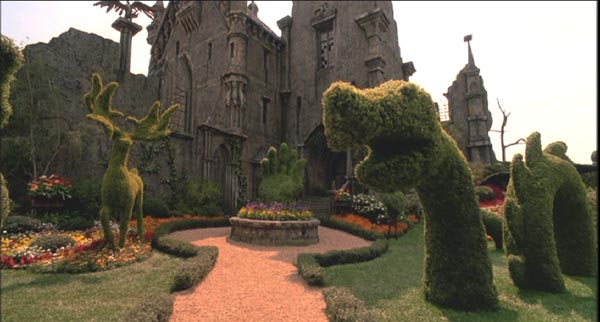
The hedges of Edward's castle

Edward Scissorhands has many elements in it that makes it similar to a fairy tale. For example, Edward lives in a castle on top of a giant hill that overlooks the town. This is similar to the fairy tale castles that reoccur in many tales, an example of this is the Disney castle. Edward is also not human, but a machine that was created by an ingenious inventor. He becomes the misunderstood monster that you see in so many stories whose only desire is to fit in. Edward’s deformity rouses people’s curiosity at first but this eventually leads to fear. Kim is also a link in the film to several fairytales; she is the beautiful girl that the monster longs for. Edwards’s condition startles Kim and makes her apprehensive at first but like so many other fables, she sees the good in him and eventually falls in love. Though their predicaments keep them apart, Edward experiences love with another person for the first time. Even though fairytales, especially Grimm’s fairytales, contain many violent elements that teach a moral; Edward is not a violent character. Sometimes he hurts people by accident, but he would never go out of his way to hurt someone intentionally. It is actually the people of the suburb that are much more sadistic than he is. They don’t even begin to try and understand him. At first they use him because they find out he is skilled in certain things, such as trimming hedges and giving haircuts, but ultimately none of them care about him. Edward physical appearance is simply too much for the townspeople to handle, making his quest for completion that much more difficult. Edward is almost immediately thrust into an environment by the Avon lady that is almost totally identical in every aspect. The houses are all the same other than the paint color and all the woman in the neighborhood are bored and petty housewives. Despite the bright and welcoming image that the town puts on, the townspeople are unkind and thrive off of gossip. An especially nasty character is Joyce, she is just as bored as all the other woman but also manages to be promiscuous at the same time. She tries to seduce Edward and when he rejects her she turns it around on him so that all the townspeople think he tried to rape her. This is just one unfortunate event out of many that lead to Edward’s exile from the town. 

Sunday, February 3, 2013

O'Connell: Catwoman

Batman Vs. Catwoman

Catwoman and Batman are both characters with complex personalities. They both have dark pasts and mysterious personal lives. The most important similarity between the two is the fact that they both have dual identities. Catwoman during the day is just a normal woman named Selina Kyle. She is a beautiful and confident woman that Bruce Wayne is instantly intrigued by. She is a much more mysterious and sexualized version Vicki Vale. But much like Bruce, she has inner struggles of trying to dicscover herself. Before she was thrown off the roof, left for dead, she was a shy and soft-spoken young woman. Her new found confidence was awoken when she came back to life as Catwoman. Her alter-ego was the answer to her desires of becoming an independent woman. It also brought her a new feeling of hatred for all men. Outside of the bat suit, Bruce Wayne is a reclusive and depressed individual that hardly leaves the house. The complexity of each character’s personality brings a certain kind of balance to their relationship. The new Selena is able to say whatever she wants without hesitation, causing her to talk to Bruce flirtatiously. Bruce is attracted to her in a way that he never felt when she was just the regular shy Selina Kyle. She is also obviously attracted to him in spite of her hatred for men. This hatred comes out when she puts on her mask. Her sense of empowerment causes her to be very aggressive towards Batman. But even under all the violence there is a lingering sense of chemistry between the two. This is what ends up being the downfall of Catwoman. Even when they discover each other’s true identities, Bruce feels that it could work out because they are so similar. He feels like he’s finally met someone who understands him. Selina, on the other hand, is still trying to figure out her true identity. She has not come to terms with herself so early in her resurrection as Catwoman. Her attraction to a man that she should hate scares her. It contrasts with her secret identity and eventually leads to her demise.  

Sunday, January 27, 2013

O'Connell: Film Noir and Batman

http://www.empireonline.com/images/uploaded/tim-burtons-batman.jpg
Batman and the Joker's final face-off

Tim Burton utilizes many elements of film noir to create his vision of Batman. The most obvious techniques being used is in the setting. Batman takes place in Gotham, a dark and urban setting that is littered with criminals. All the buildings are huge and angular; they are also pressed tightly together. This gives the city a claustrophobic feeling which is common of film noir.  Another characteristic of film noir is “Harsh, low-key lighting brought about the high contrast and rich, black shadows.” There is an example of this in almost every scene. Much of the characters are partially covered by shadow or are in a setting where there is an opposition of dark and light. The dark setting of the film matches the conflicted personality of Batman. His life has been shrouded by darkness from a very young age. The contrast between dark and light is a representation of the battle between good and evil or Batman vs. The Joker. The corruption of Gotham city and its dark shadows invoke a feeling of hopelessness. This caters directly to Burton’s theme of alienation. The city seems isolated and the citizens are clueless with no direction.
When it comes down to the “conflicted heroes” of film noir, this film has two characters that perfectly fit this description. The Batman still suffers from witnessing the death of his parents and carries around a sense of guilt. He hides away in his mansion and only feels totally comfortable when he’s fighting crime in his bat suit. This guilt gives him a sense of responsibility to uphold the law. The Joker could easily be labeled as a sociopath. He was a “hard-boiled” criminal to begin with but when he becomes physically deformed he becomes totally unhinged. The Joker is free of all obligations and isn’t held back by feelings of remorse. He does whatever he wants and follows through on every urge he has. The character that best fits the description of the “femme fatale” would be Vicky Vale. She is a seductive and intelligent reporter that Bruce Wayne is instantly drawn to. She also fills the role of the “damsel in distress” as Batman always saves her when she’s in trouble.
                 

Friday, January 18, 2013

O'Connell Death Denial in "Beetlejuice"

http://notofgeneralinterest.blogspot.com/2012/08/it-takes-village.html

                Americans deny death because it is much easier to deny it than to acknowledge and deal with it. Many people want to quickly move on with their lives rather than dwelling on the past. This way they can avoid the grief and sadness that comes along with it. Beetlejuice denies death in the way that it makes the afterlife seem not so different from regular life. In real life when someone dies, that is the end and you don’t know what happens after that. Burton’s film makes it seem like death is just a continuation of life that doesn’t really change. In fact he makes death seem more tedious than life because it is portrayed as endless waiting rooms with endless amounts of paper work. Even in the afterlife, people still have jobs and deadlines. Rather than a care-free paradise that most people expect the afterlife to be, the Maitlands are confined to their home and still have obligations to fulfill. Similar to the way that Americans refuse to incorporate the reality of death into their lives, Beetlejuice does the same thing. After the death of the Maitlands, there is no funeral or grieving relatives. The film skips past this aspect of death completely and makes it seems like the Maitlands are just returning home to their regular lives when they are, in fact, dead. The fact that they don’t even know they’re dead at first is another indication of death denial. The film utilizes black humor to turn situations that would usually be tragic into comedy. The casual approach the film takes to death lightens the mood and drains it of any sadness. An example of this is the team of dead football players who died in a plane crash. A group of young athletes perishing in a plane crash would usually be tragic but the film turns it around by having the players believe that Juno is their coach and that they don’t know they’re dead. Juno’s sarcastic reaction to them further brightens things and causes the audience to view it comically rather than tragically. The afterlife portrayed in Beetlejuice is, in itself, an example of death denial. 

Tuesday, January 8, 2013


My name is Yamato O’Connell and I am an Undecided General Studies Major. I chose this class because I have an interest in film and want to incorporate it into whatever I choose as a profession. I was born and raised in New Orleans and went to high school down the street at Lusher Charter School. I commute to school by car and live with my parents downtown in the Marigny. I chose to go to Loyola because my mother is an immigration lawyer at the Loyola Law Clinic. I have a little sister who is a sophomore in high school. My mother is from southern Japan and my father is from Minnesota, I am bilingual in both Japanese and English. I usually visit Japan every summer for a month and a half to visit my grandparents and the rest of my family on my mother’s side.  In my spare time I love to watch a wide range of films. I also draw and listen to music. I was in the visual arts program at my high school for two years before I realized it was not something I wanted to pursue. My favorite types of movies are independent films that don’t reach mainstream theaters and I am also very intrigued by foreign films. I especially like Hispanic and Asian films. My favorite genre is horror. This is due to the fact that the first big film I remember watching is Poltergeist from a very young age. I love a lot of Tim Burton’s films including Beetle Juice and Ed Wood but I think he could really benefit from taking a break from making movies with Johnny Depp. My least favorite type of genre is musicals because I prefer dialogue to singing. My favorite directors at the moment include Quentin Tarantino, Kiyoshi Kurosawa, and Christopher Nolan. My interest in film began when I would watch many different films with my father starting from a young age and I had a movie rental store within walking distance from my house. I hope this class with help me to understand how I want to incorporate film in to my profession.